On January 15, 2025, the Louisiana Endowment for the Humanities (LEH) announced their Documentary Photographer of the Year was awarded to Pableaux Johnson. He was grateful that his work was being recognized but too humble to share the news just yet. Pableaux was all about stepping up for others, whether behind the camera or in the kitchen, and I was looking forward to seeing him and his work celebrated.
After his sudden passing on January 26, there is a hole in the heart of the community that revolved around him and his generous spirit. As a testament to him I am sharing the testimonies from the many people who supported Pableaux’s award nomination. I hope they convey the essence of a wonderful, kind, giving person as a ‘thank you’ to the way he captured our essence in photographs and made our lives better with his presence.
Here is the notice of Pableaux’s award:

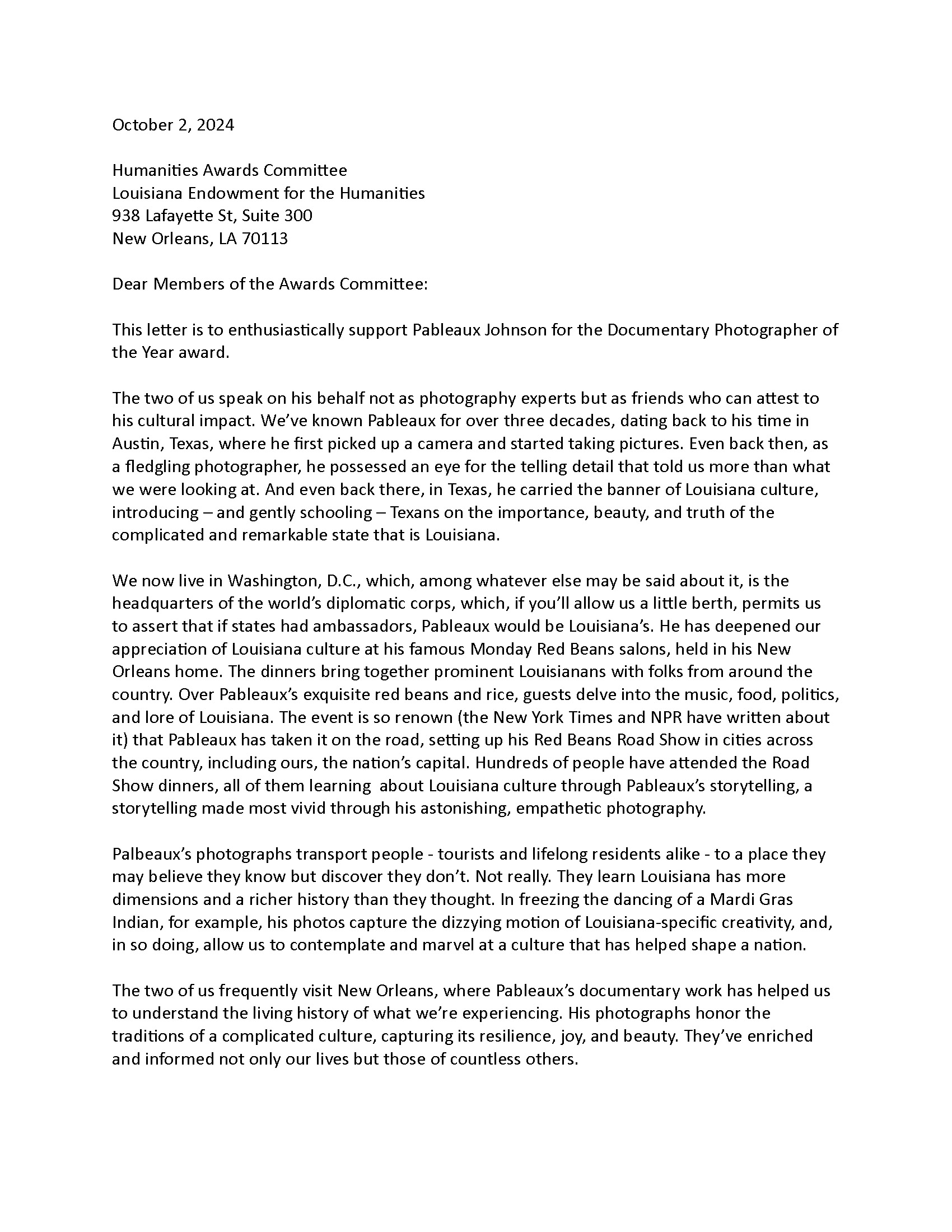
And here is the nomination letters submitted on Pableaux’s behalf:
I’m thrilled to nominate Pableaux Johnson as LEH’s “Documentary Photographer of the Year.” His portfolio has been posted online HERE. Mr. Johnson has been documenting all aspects of New Orleans culture since 2001 and is recognized for his signature style of capturing heart-stopping action shots of culture-bearers in the streets. The letters of support included in this application attest to his amazing body of work and the close relationships he has built in our community:
- Norman Dixon, Jr., President Young Men Olympians, Chairman of Norman Dixon Sr. Foundation
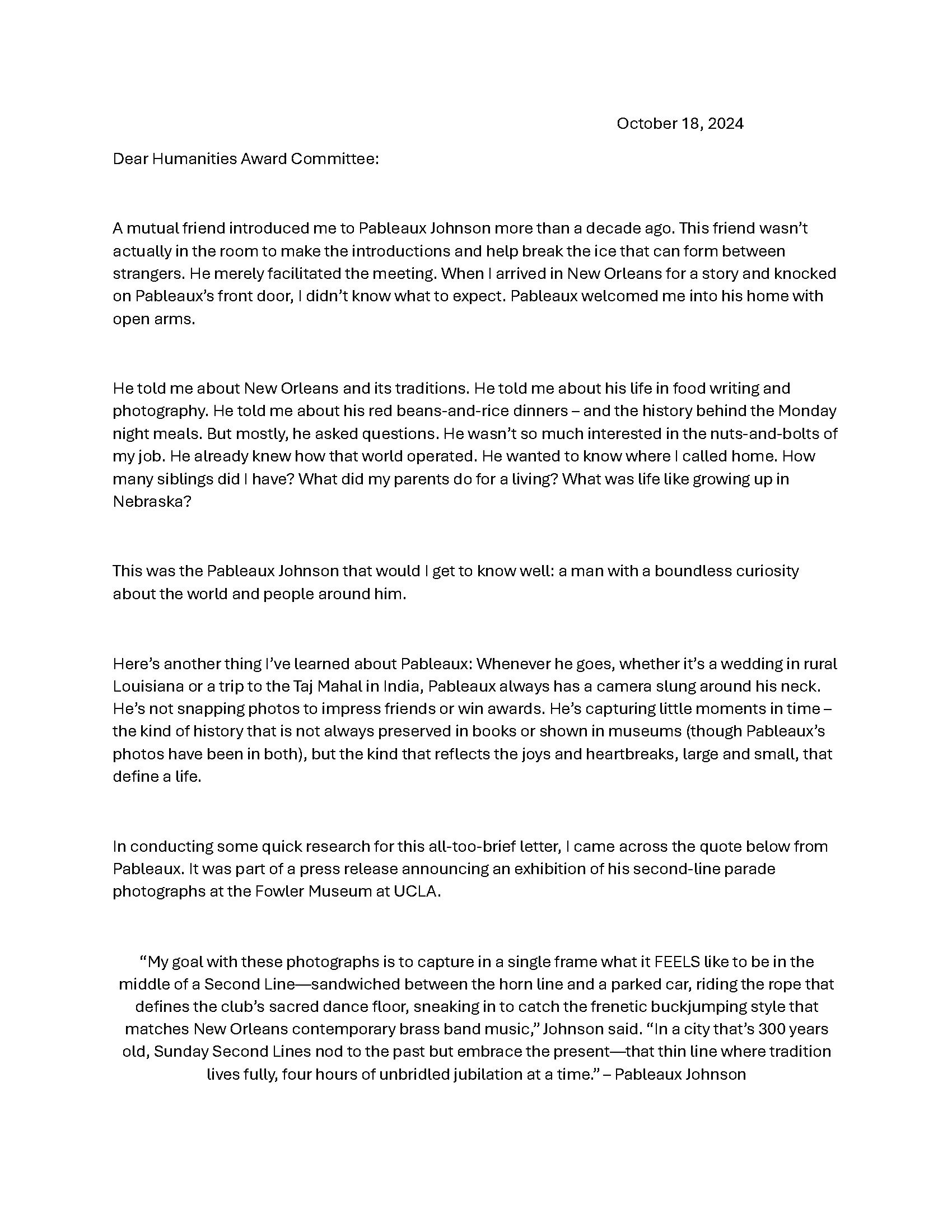
- Dr. Patrick Polk, Senior Curator of Latin American and Caribbean Popular Arts, Fowler Museum at UCLA
- Rachel Breunlin, Director, Neighborhood Story Project
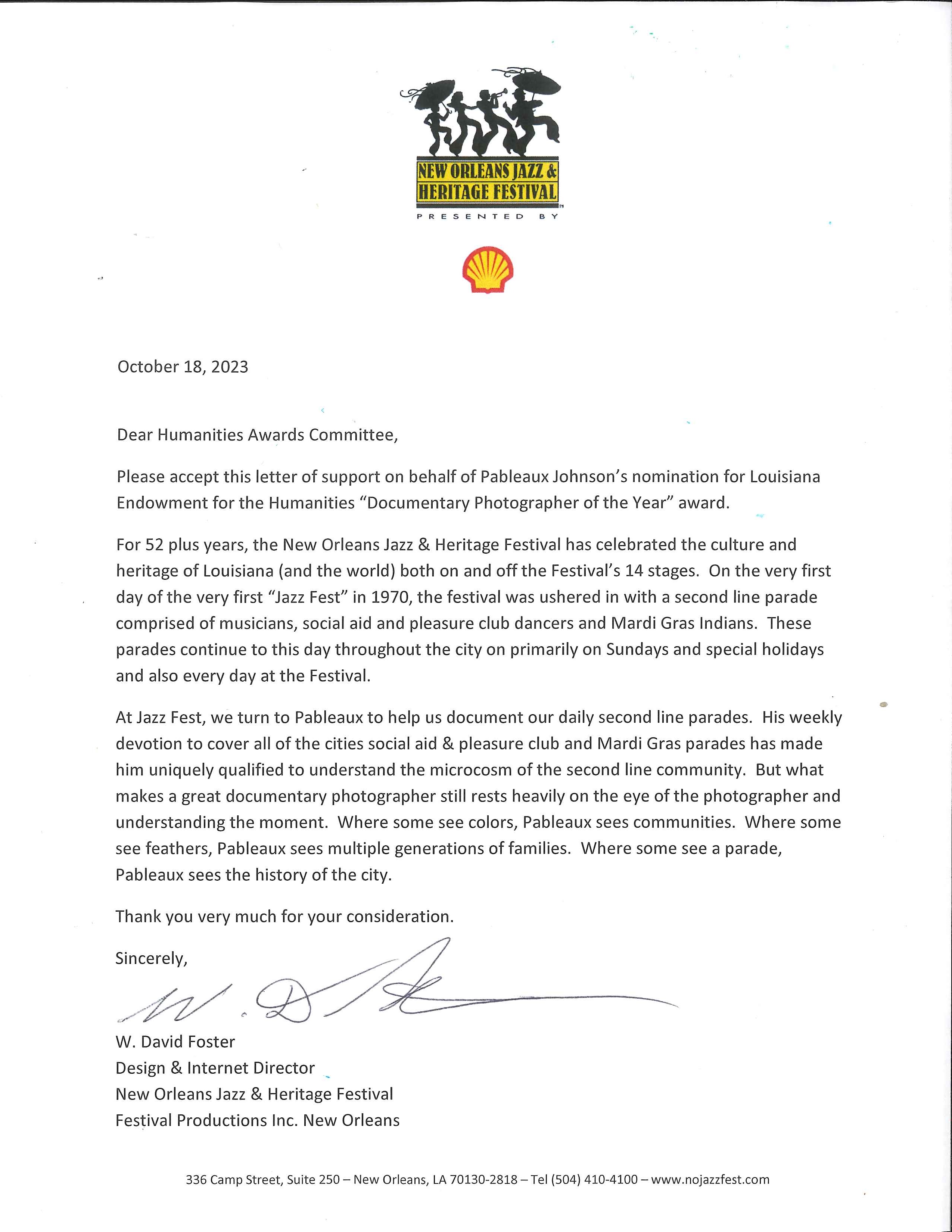
- W. David Foster, Director, Design & Internet, New Orleans Jazz and Heritage Festival
- Tyrone Casby, Big Chief of the Mohawk Hunters Mardi Gras Indians, retired principal, L.B. Landy High School
- Dawoud Bey, MacArthur Fellow and Prof. of Photography, Columbia College Chicago
- Jim and Jessica Shahin, Professor Emeritus, Journalism, Syracuse University and Associate Administrator, Supplemental Nutrition Assistance Program (SNAP), Retired
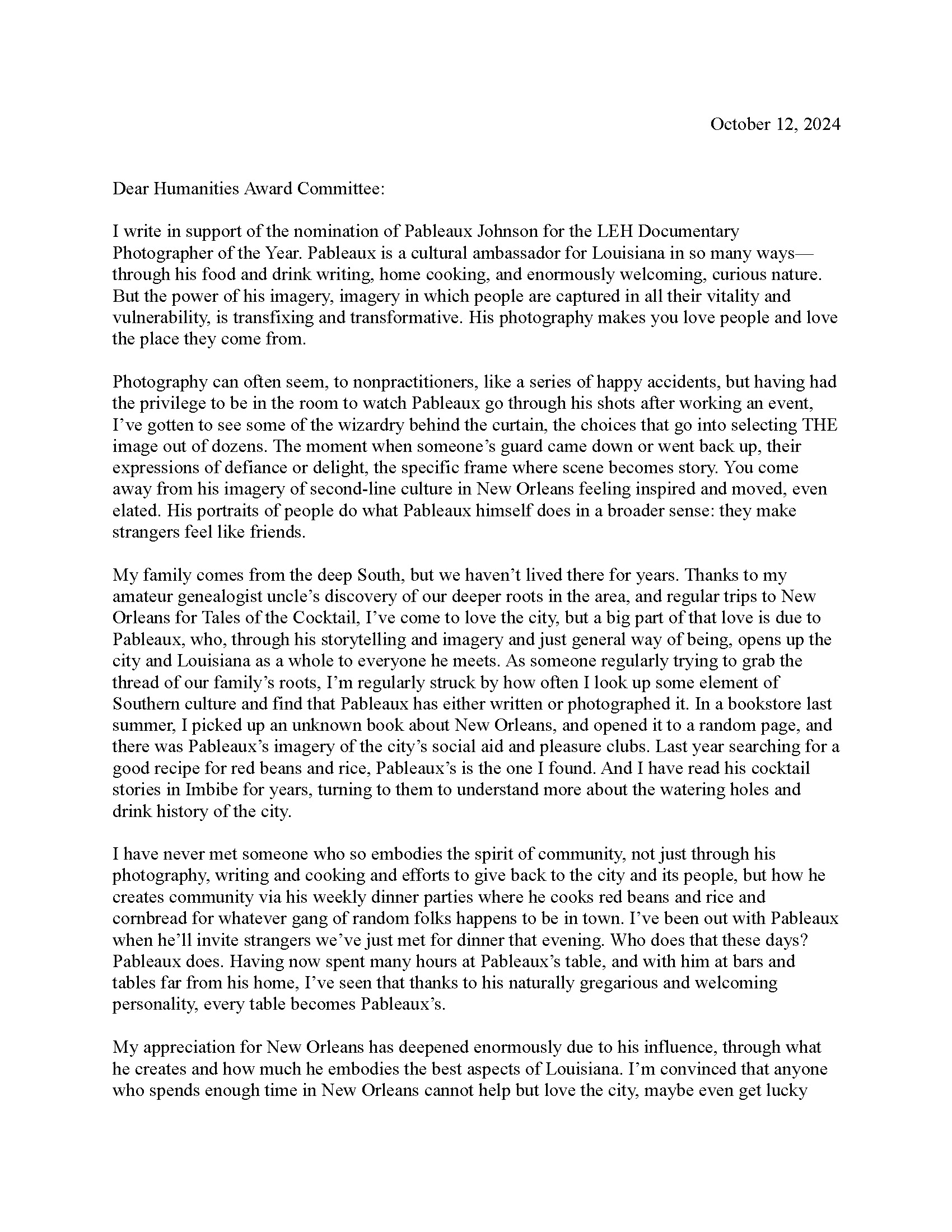
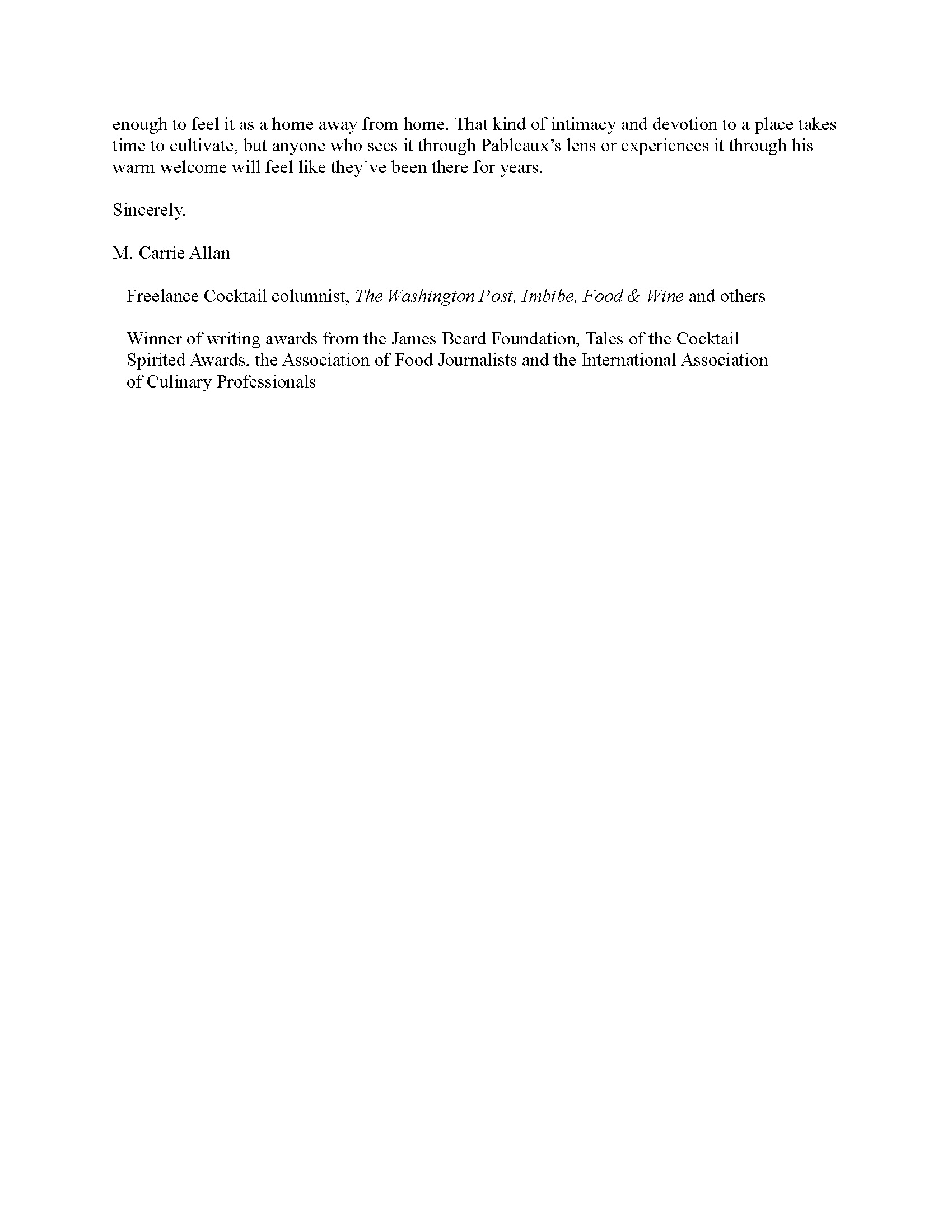
- M. Carrie Allen, Cocktails Writer, Washington Post, and Senior V.P. of Communications at the U.S. Humane Society
- Tim Carman, Food Reporter, Washington Post
Pableaux Johnson was raised in New Iberia, Louisiana, with an intimate understanding of Cajun foodways through his family’s home-cooking. He worked for years as a food and travel writer, publishing with the likes of the New York Times, Saveur, Food and Wine, and Bon Appetit, and writing the books Eating New Orleans: From French Quarter Creole Dining to the Perfect Poboy (2005) and Lonely Planet’s World Food New Orleans (2000). While his photographs often accompanied his writings, it wasn’t until after moving to New Orleans in 2001 that he began to immerse himself in documenting the city’s living traditions and forming lasting relationships with cultural ambassadors. He has amassed an archive of tens of thousands of images of Black Masking Indians, brass band musicians, Social Aid & Pleasure Club Members, and school marching bands. In addition to photojournalism and museum shows, Pableaux is known above all for “repatriating” his work: he freely gives prints and digital copies of to the subjects themselves. This commitment to reciprocity — with hundreds if not thousands of New Orleanians — adds a crucial ethical dimension to his work.
There are numerous photographers who focus on outdoor performance traditions in New Orleans but Mr. Johnson’s images stand out because of a signature aesthetic approach. On the one hand, he is an action photographer, always responding in the moment in “live” events such as second line parades, jazz funerals, Mardi Gras parades, Super Sunday, St. Joseph’s night, and Jazz Fest. On the other hand, Mr. Johnson’s lens is drawn to individuals, capturing portraits of people as they go about their intense dedication to their craft in the moment. The result is an intimate glimpse of someone’s unique spirit and individual flair: flashing gold teeth, a handsewn beaded patch, a meticulously close fade hairstyle, wide-brimmed lavender fedora, or personalized dancemove. From a technical perspective, this intimacy requires enough proximity to capture facial expressions that say so much but from a respectful distance that does not interfere with dancing, strutting, or playing an instrument. But there is an unspoken political element as well: because most subjects are Black New Orleanians and they invest such deep pride in their local traditions, there is a profound dignity to the expressions of joy, mourning, and even ferocity in the case of Indians or marching band members. Notice how the portraits are often at eye level or looking up, so the subjects are rendered are life-size or larger-than-life, never diminishing or patronizing them.
Mr. Johnson’s artistry has been recognized through solo exhibitions at four university galleries, the Fowler Museum of Global Arts and Culture at UCLA (“New Orleans Second Line Parades”), the Center for the Study of Southern Culture at University of Mississippi (“Of the Nation: New Orleans Mardi Gras Indians”), and the Center for the Study of the American South at University of North Carolina Chapel Hill (“New Orleans Second Line Parades”), and Ohio State University, Newark (“Of the Nation”). His still images formed the basis for the documentary films “Spirit Leads My Needle” and “It’s Your Glory” produced by Ohio State University. And he was an integral part of the Historic New Orleans Collection’s group exhibition “Dancing in the Streets.” Mr. Johnson’s images have been featured in numerous journalism stories, including his own articles in Bitter Southerner (“Wild Creation”), LEH’s previous magazine Cultural Vistas (“Indians of the Nation”), Southern Cultures (“Forty Sundays a Year”)and much more.He was also the first guest on LEH’s The Frame: A Louisiana Photography Podcast, hosted by Zack Smith.
Mr. Johnson’s work is not limited to local performance traditions. He has photographed countless restaurant owners and chefs, along with the annual meetings of the Southern Foodways Alliance for over a decade. The same can be said for bartenders and mixologists, culminating each year with his work for the Tales of the Cocktail conference. He is famous for his Monday night Red Beans dinners, his modest dining room table always buzzing with artists, writers, and the occasional journalist writing a story about him. (Google “red beans and rice recipe” and his New York Times Cooking article is the first hit.) I mention this because Mr. Johnson is not just a photographer for hire; he is the hub of a wheel with spokes that connect far and wide, bridging art and culinary worlds with local performance traditions that are too often segregated.
As a professor at Tulane who has written books and articles about New Orleans culture, and specifically as a white man who represents Black culture-bearers in my work, I am inherently part of a long lineage of “outsiders” who have rightly been accused of “parachuting” in and out of Black communities, extracting other’s work and knowledge for personal gain. I have never met someone so dedicated to overturning this history through an unwavering commitment to reciprocity and respect. First, Pableaux provides physical photographs to the various organizations and participants in an ongoing manner. Second, he posts his work on social media and “tags” subjects (with their permission), as well as constantly providing copies by text, email, and direct messages. Third, he enables ready access to images from the city’s distinctive celebrations and events through his website and elsewhere, but critically he splits any fee he receives with the subjects of the photographs. Finally, his captions always credit subjects and their organization by name, never anonymizing people or their individual talents and personalities. The humanity that comes through in his portraits is extended through his relationships as a welcome community-member in any setting throughout the city. Attending a parade with Mr. Johnson is a bit like participating in a “receiving line,” but much more rollicking and improvised as he bumps into (and photographs) one acquaintance after another.
Because Mr. Johnson has been nurturing relationships for over two decades, he has amassed a startling archive of images. He has preserved photographs of people, families, and organizations stretching back for years, tracking the growth of children into adults, capturing the progress of Indian suits from year to year, or even documenting change in traditions through different historical eras. When Neighborhood Story Project worked with the Young Men Olympian Benevolent Association to produce a book, Mr. Johnson was able to draw upon dozens of annual parades and member’s jazz funerals. When I published an article on one club member, Alfred “Bucket” Carter, he had photographs not only of Bucket’s jazz funeral but his presence at numerous parades and funerals dating back to the immediate aftermath of Hurricane Katrina. A photographer who is a stranger cannot match this kind of breadth and depth, and the humanity of his subjects cannot be conveyed in a distant wide-shot of an anonymous group of people. It can only be accomplished by someone up-close, in every sense of the term.
I have invited several others who know different facets of Mr. Johnson and his images to provide letters of support attesting to his worthiness of your award in documentary photography. Also included is a portfolio of his photographs that is meant to convey a diversity of subject matter but with an intimacy that is unform throughout. I am confident you will agree that Mr. Johnson’s body of work speaks for itself and look forward to your decision. (If you need links to any of the work cited here or anywhere else in this application, please contact me at the email address below).
Sincerely,
Matt Sakakeeny
Associate Professor of Music
Tulane University





 Matt Sakakeeny